Cloud Is Time Share, But So Fast It's Invisible
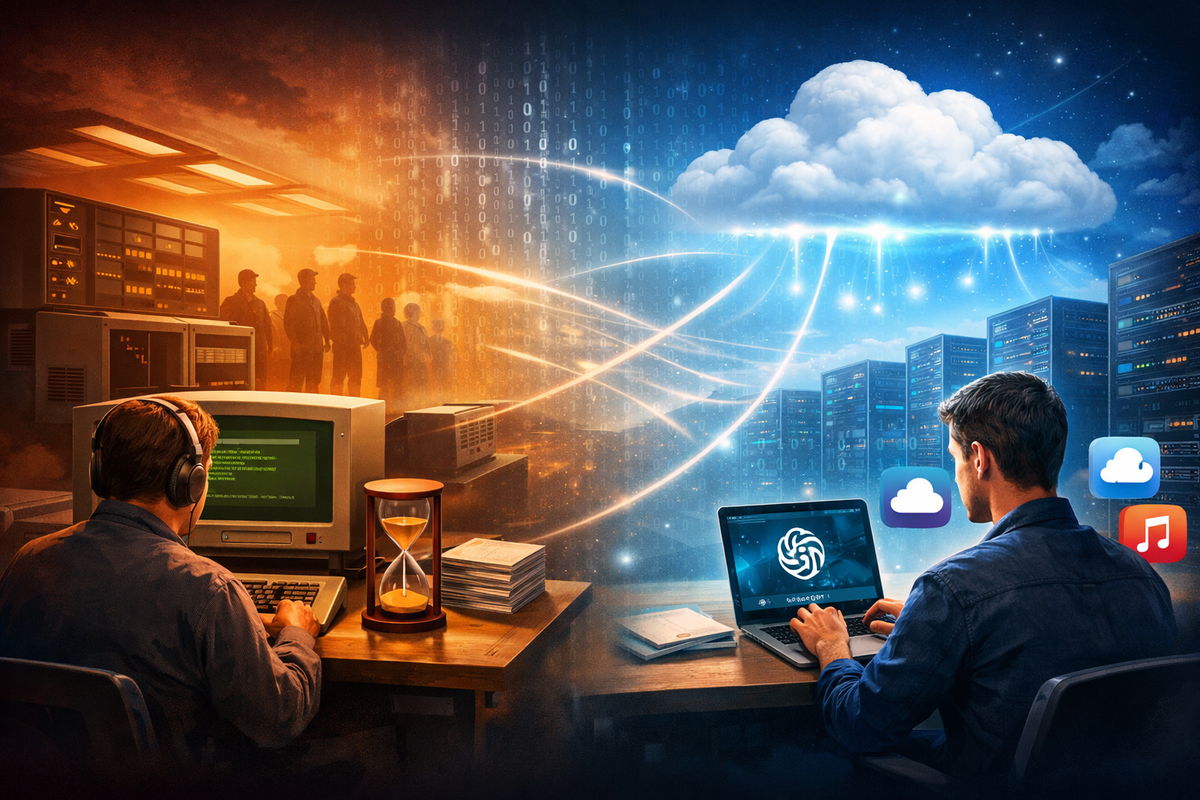
I just installed the Facebook app on a freshly reinstalled Windows 11 laptop. A 17 inch 2019 HP Omen, i7, 16GB of RAM, NVMe boot drive, GTX 1070M. It ran Linux for a long time after I finally got tired of Windows 10. But when Windows 11 came out and everyone else was loudly declaring they were done with Windows, I jumped back on. This machine has a permanent license, so there was no purchase, no friction, no ceremony. Everything snapped into place instantly. Then I installed the ChatGPT client. Same experience. Immediate. Responsive. It feels local, personal, owned.
And yet none of it is. These days this machine spends more time acting as a terminal than actually processing anything itself. Maybe an Excel spreadsheet here or there, though even that likely came from OneDrive. Mostly, it is just a fast window into responses generated somewhere else. Still a terminal.
Every bit of this is running somewhere else. In data centers most of us will never see, slicing millions of processing threads across networks that routinely move ten gigabits per second. Compared to what we grew up with, this is absurdly fast. Compared to the old days of time share, it barely resembles the same idea.
Back then, time share announced itself. You could feel it in your bones. Jobs went into queues. You waited. The machine reminded you that you were not alone. Downloading a one gigabyte file over a 128k connection was not just slow, it was a commitment. You planned around it. You hoped nothing failed. You knew other people were competing for the same limited resources.
The friction was the point. The slowness made the system visible.
Today, that same file crosses the wire in seconds. Often you do not even notice it happening. The wait is gone, and with it the cues that reminded you of the bargain you were making.
That is the real shift.
Cloud is time share, but it is fast enough to feel like ownership.
We are all sharing compute now, just at a scale that breaks intuition. Instead of a few users dividing a mainframe, we share planetary infrastructure. Millions of cores. Vast memory pools. Storage deep enough to feel endless. Latency low enough that your brain stops asking where things live.
Speed changes psychology.
When time share was slow, you understood the deal. You traded control for access. You accepted limits. You learned patience, or you learned how to work around the system. Either way, you knew where you stood.
Now the bargain hides itself. The interface is smooth. The response is instant. The abstraction is nearly perfect. It feels like the machine is yours even when it very clearly is not.
Facebook. ChatGPT. Streaming music. Cloud storage. AI copilots. All of it lives in someone else’s data center, running on someone else’s schedule, governed by someone else’s rules. You are no longer waiting for CPU cycles. You are sharing them so efficiently that the sharing disappears.
That is why this is harder to resist.
You can argue philosophy all day, but the practical reality is simple. The performance gap is too wide. The convenience is too real. The economics are too compelling. Nobody wants to go back to overnight downloads or waiting weeks for hardware to arrive.
So the question is not whether we can stop this. We cannot.
The real question is what we lose when speed erases awareness.
In the old time share world, you knew you were renting. In the personal computer era, you knew you owned the machine. Today the line is deliberately blurred. Ownership feels emotional instead of technical. Control feels implied instead of actual.
Into that blur step certifications, platforms, consoles, roles, and managed services. Knowledge gets re siloed under corporate umbrellas. You know your dashboard. You know your permissions. You know your slice. You do not know the whole.
That model scales. It is efficient. It also reshapes how engineers think.
When everything is abstracted and fast, understanding starts to feel optional. Curiosity becomes friction. Deep system knowledge gives way to interfaces that promise you do not need to know what is underneath.
Gen X sits in an odd place here. We remember slow networks and screaming modems. We remember when downloading a file was a decision with consequences. We also live comfortably in a world where gigabytes move without thought and AI responds in real time.
This is not an anti cloud argument. It is not anti progress. It is memory.
We remember when the machine showed its seams.
Cloud is time share perfected. Smoothed. Accelerated until resistance disappears. The cage is still there, but you do not feel the bars because everything moves at the speed of expectation.
So can we fight it. No, not really.
But we can remember what it means to understand systems instead of just using them. We can teach curiosity alongside convenience. We can remind people that behind every instant response is a real machine, burning power, moving data, and obeying physics.
Because the danger is not that we are sharing compute.
The danger is forgetting that we are sharing at all.
--Deep Thoughts Always
-Bryan