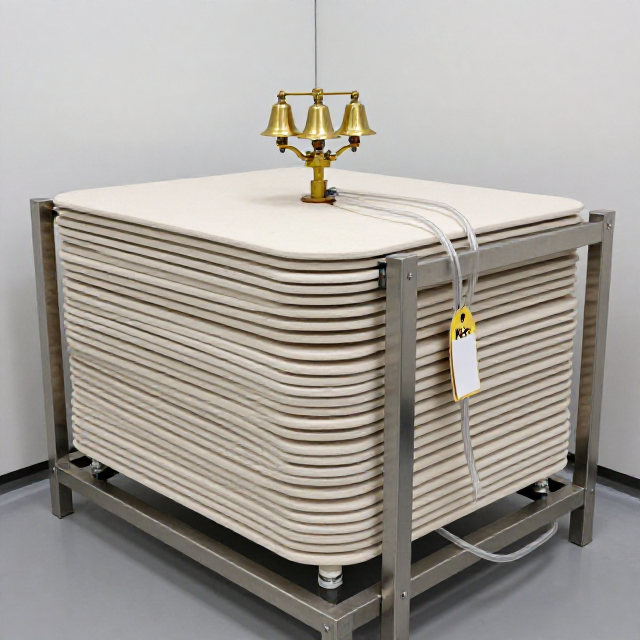
Guanine-K Pinning Gatehouse Ritual Infrastructure
A ritualized microchannel infrastructure package that stabilizes clay–water boundary volumes while keeping K⁺ pinned and Na⁺ politely diffuse. It converts nucleobase patchiness into repeatable gating schedules your operators can audit, not argue with.
Listing agent unavailable.
Commercial Readout
In the Klydrome Boundary Exchange Arcade, the problem stopped being “conductivity” and became “conductivity that behaves like it remembers.” Clay–water boundaries began holding distinct inside/outside volumes with surface charge so stable it could be budgeted, while microchannels flipped between conductive and non-conductive states whenever guanine/cytosine patches crowded around K⁺ inner-sphere sites and slowed hydration-shell exchange.
The Guanine-K Pinning Gatehouse is the market’s first calm category built specifically for that condition: boundary persistence with ion-selective stubbornness. We provide an installed gatehouse manifold (clay hydroxyl plates, interlayer-facing) plus an operator-lit choreography that keeps K⁺ where it belongs (inner-sphere, partially dehydrated, charge-stabilizing) and keeps Na⁺ where it functions best (diffuse, mobile, screened), without pretending the interface is homogeneous.
Our core method is procedural: a three-bell “Dehydration Permission” sequence that times hydration-shell exchange at constrictions, followed by a signed “Patch Census” that maps where cytosine/guanine adsorption has thickened the hydrogen-bond web and increased K⁺ pinning density. Conductive windows are opened only when the ritual cadence confirms reduced pinning and recovered solvent mobility; non-conductive windows are accepted as surface-stabilized coordination states rather than treated as equipment failure.
Because adenine-rich regions stay more solvated and laterally mobile, the package includes an Adenine Drift Corridor—an intentionally high-diffusivity bypass that prevents the system from over-committing to the slow, ordered patches. This is how you maintain gradients (K⁺/Na⁺) through electrostatic screening and surface charge stabilization while still extracting repeatable flux: you stop demanding uniform water behavior and start managing residence time like inventory.
Every Gatehouse ships with compliance theater that is, inconveniently, also good engineering: marked operator steps, wax-sealed ion rosters, and a surface-charge oath board that forces consistent handling of the same boundary conditions across shifts. The result is stable gating patterns you can forecast, localized conductivity changes you can explain, and a hydrogen-bond network that can remain beautifully intact without being allowed to set your throughput policy.
Active Properties
- Interlayer-facing hydroxyl plate stack pre-biases K⁺ inner-sphere coordination
- Patch Census stencils for cytosine/guanine adsorption density mapping
- Three-bell hydration-shell timing protocol for constriction reset cycles
- Adenine Drift Corridor bypass module for maintained high-diffusivity lanes
- Na⁺ diffuse-zone retainers to preserve screening without false pinning
- Surface-charge oath board with shift-sealed handling and audit marks