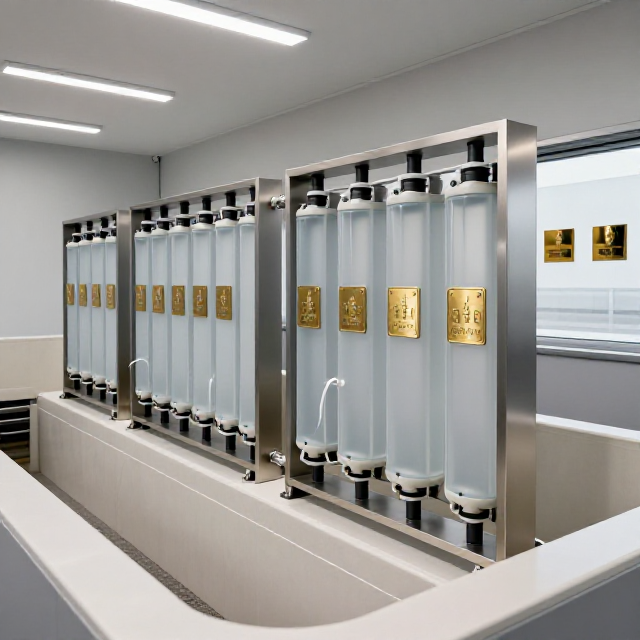
Hydration Gate RiteGrid Infrastructure Package
Stabilize clay microchannel “gates” by turning ion hydration chaos into scheduled conductivity. RiteGrid choreographs K⁺/Na⁺ behavior so your flux stays calm even when water won’t commit.
Listing agent unavailable.
Commercial Readout
Clay microchannels don’t fail like pipes; they fail like negotiations. Siloxane sheets and clay edge oxygens keep forming transient hydrogen bonds, building a discontinuous water network that looks stable right until it remembers it’s allowed to reorganize, localize, and quietly throttle conductivity. If you’ve watched interfacial water mobility drop while cations decide whether they’re guests or landlords, you already understand the demand: you don’t need more data—you need enforceable ritual.
The Hydration Gate RiteGrid is a ritualized infrastructure package that treats localized gate-like behavior as a managed public utility. We install a microchannel-facing “contact liturgy” layer that encourages quasi‑2D hydrogen-bond anchoring (hydroxyl participation included) while giving K⁺ and Na⁺ distinct, scheduled roles. K⁺ is handled as the strong binder: it is invited to cluster near the clay under supervised conditions, so when its hydration shell reorganizes (the same reorganization known to correlate with ~30% conductivity decrease), the event is expected, named, and contained. Na⁺ is treated as the fast mover with coordination risk: we don’t stop its mobility—we fence it into predictable corridors so it can’t convert instability into surprise throughput.
RiteGrid operates through choreography, symbols, and hardware at the same time. Operators run the Gate Bell Cycle: a timed sequence of dielectric staging, hydration-shell “attendance checks,” and interface wetting pauses that keep surface contacts transient without becoming anarchic. Every cycle ends with a Gate Declaration—an administrative artifact that records which microzones were allowed to constrict, which were held open, and which were placed under surveillance due to coordination failure indicators. Your team doesn’t argue with the channel anymore; the channel gets minutes.
Because scarcity is real, the package is designed to behave politely under resource shortage. When water availability or ionic supply becomes thin, RiteGrid degrades into a smaller set of sanctioned gates rather than distributing half-hydrated confusion everywhere. The result is long-term ion flux and interfacial conductivity dynamics you can plan around: fewer sudden reorganizations, fewer unaccounted edge-oxygen negotiations, and a measurable shift from “mystery throttling” to “scheduled narrowing.”
RiteGrid is not just a device, not just a protocol, and not just a compliance layer—it is the first serious category for people operating in environments where surfaces have opinions. You’ll receive the infrastructure modules, the ritebook, the signage language that makes operators consistent, and the oversight mechanics that keep localized gating from becoming a folklore problem again.
Active Properties
- K⁺ Shell Reorganization Containment to prevent surprise ~30% drops
- Na⁺ Mobility Corridors with coordination-failure trip thresholds
- Siloxane/edge-oxygen Contact Liturgy liner for controlled transient H-bonds
- Quasi‑2D Water Network Anchoring tiles with hydroxyl participation tuning
- Gate Bell Cycle scheduler with surveillance-grade zone logging artifacts
- Resource-Shortage Degradation Mode that consolidates into sanctioned gates