The Route Between the Goats
Helix, MindVault, GoatCountySim, GoatISPSim, GoatOS, and GoatMUX point toward a development lab built from distinct systems. The records show the foundations, the boundaries, and the still-unverified distance between a plan and an integrated lab.
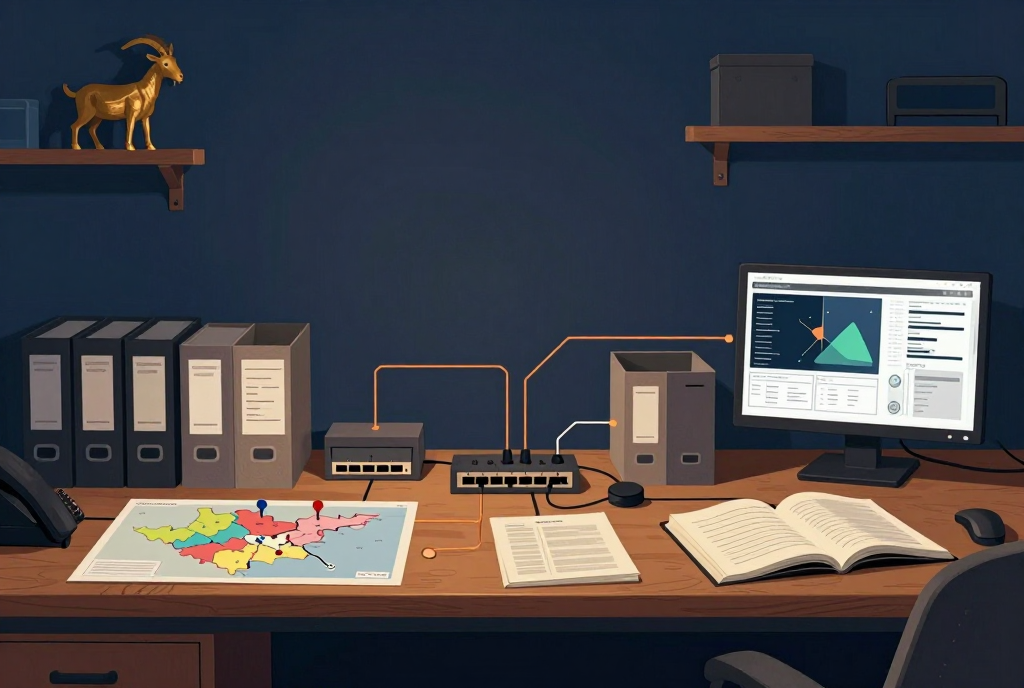
The Route Between the Goats
GoatMUX is easiest to misunderstand if you picture a single application growing extra features. The records point toward a different shape: several systems with different jobs, gathered under one development-lab name and connected where a real boundary can be drawn.
That distinction matters because the problem Bryan keeps returning to is not simply a shortage of software. It is the distance between useful pieces of information. An account is in one system; a device, a service, a ticket, or a path through a network is somewhere else. A tool can show each piece and still leave the person investigating to do the joining in their head.
First, make the path visible
Bryan’s supplied context describes work across computer repair, telecommunications support, network operations, search infrastructure, and systems engineering. It presents his method as practical: observe what a system does, follow the evidence, and understand the whole path rather than stopping at the first plausible answer.
At CNI, where the note places him from roughly 2004 to 2018, Bryan built CableView, a cable-modem management system. The source does not provide a feature-by-feature history. It does place CableView in an operational world where technicians needed scattered information made useful for investigation. At Elastic, from 2018 to 2020, he worked with search infrastructure, indexing, and distributed systems. These experiences provide context for later projects; the available notes do not establish a single, uninterrupted product lineage.
Helix carried that operational question into telecommunications: if evidence is split between customer records, provisioning, tickets, signaling, telemetry, maps, and engineering material, how can an investigation move between them without pretending they are one database?
Bryan’s context describes Helix as an intelligence layer over systems that continue to own their own work. Its relationship model is compact enough to read as a route:
Account → Service → Address → Device → Telemetry → TicketA technician can begin with a phone number, account, serial number, ticket, network node, or symptom and follow connections to relevant context. The context document describes Helix as using Go services, MariaDB Galera, OpenSearch, Grafana, ingestion and preprocessing, telemetry, operational knowledge, and AI-assisted research. The technology stack is not the point by itself. The design question is whether an operator can move from “something is wrong” to evidence about what is affected and where to look next.
The same note lists investigations spanning voice signaling and media, cable and fiber problems, DSL configuration, provisioning, physical routes, engineering drawings, and Wi-Fi interference. The practical implication is that a fault may cross multiple systems; the investigator needs the relationships between records, not another isolated pile of them.
MindVault applies a related idea to Bryan’s personal archive: content identity can remain stable while a file’s path changes, and retrieval should resolve that identity to its current cataloged location. This is a bridge to the Goat* work, not its subject. The value is provenance: a result is more useful when a person can find the material behind it.
This is the bridge into the Goat* projects. The GoatMUX name began with an earlier SIP experiment; Bryan’s context says he later chose it as the umbrella identity for connected work, with “MUX” suggesting the combining of independent streams. The name signals ambition, but it does not mean every project should be poured into one codebase, database, or process. The stated direction is a lab experience over systems that remain independently operable.
Different worlds, different jobs
GoatCountySim and GoatISPSim make the reason for those boundaries concrete.
GoatCountySim is the society simulation. Its README describes a geographically grounded county, residents with continuity and routines, social interaction, memory, operator tools, and eventually a controlled public view. The README reports a first county slice with an Atlas finder and a Full map, backed by an imported Mercer County pilot set of 56 municipalities and 281 places. The README also says the source snapshot date is unknown; those imported places are a seed for the simulation, not a claim about current real-world geography.
A roadmap marked “Active build” and dated November 6, 2026 reports a 200-resident, 80-household pilot cohort. It describes a standalone Go simulation worker, persisted simulation time, operator run controls, resident schedules, map inspection, and a separation between canonical state and searchable event history. Its details are dated implementation notes, not a live runtime check, but they show the project has moved beyond a map-shaped mockup: the design is trying to make the simulated world inspectable and its changes traceable.
GoatISPSim looks at a neighboring world from a different seat. Its README calls it a local-first ISP operations simulator and describes the current repository foundation as a Go API, a React/Next.js operator interface, and administrator authentication. It says simulation behavior and telemetry generation are later development slices. The same README is explicit that GoatISPSim has its own MariaDB data boundary and does not read or write GoatCountySim or GoatMUX schemas.
The ISP roadmap, updated November 10, gives the project’s destination: an operator-controlled simulation of roughly 20,000 persistent synthetic subscribers, with devices, customer networks, provider infrastructure, services, incidents, telemetry, and a support desk. Twenty thousand is a roadmap target, not a current subscriber count. The design asks that a simulated service failure produce evidence an operator can follow: what subscriber and device were affected, what path they depend on, what ticket was opened, and what happened next.
The county and ISP simulators can share a concern with networks without becoming the same simulation. One asks what a resident, household, institution, or town does over simulated time. The other asks how an ISP’s customers and services behave when devices, links, or provider systems change. The difference is not cosmetic. It determines which project owns the data, rules, and meaning of an event.
GoatOS sits nearby as an infrastructure and observability environment. Its mission statement describes a local-first synthetic ISP lab built for operationally realistic telecom workflows, with OpenSearch-backed investigation, synthetic network services and activity, support workflows, telemetry, alerting, and local AI-assisted orchestration among its goals. It also puts weight on reproducibility, explicit integration points, and systems that remain debuggable by a human. Those are stated aims, not a blanket claim that every component is currently deployed.
The relationship among the projects is easier to see as a plan than as a monolith:
GoatCountySim ── resident/social meaning ──┐
                                           ├── explicit APIs and events ── GoatMUX voice
GoatISPSim ───── subscriber/service meaning ┘
          │
          └── operational evidence and telemetry ── GoatOS / lab visibility
This is an architectural sketch of intended boundaries, not a report that every arrow is already connected. The county roadmap calls for a mock phone provider first. It describes a later authenticated, versioned connection from an ISP-owned telephony adapter to GoatMUX; in that arrangement, GoatMUX executes calls and owns voice-platform telemetry, while GoatCountySim owns the resident, household, scenario, and social meaning. Bryan’s supplied brief separately says CountySim can request voice behavior through an explicit GoatMUX API boundary. The available records do not show that as a verified end-to-end run. GoatISPSim lists GoatMUX voice as an optional integration while keeping subscriber, service, ticket, and network data in its own system. The broader GoatMUX context proposes shared status, logs, metrics, service discovery, and end-to-end scenarios as ways to make separate systems feel like one lab.
That separation is a practical answer to a familiar engineering temptation: if two projects need to share information, give both of them direct access to the same database. The supplied design direction argues for stable APIs and event contracts instead. Each system can then own its rules and data, and the interface becomes the part that is tested. A phone call can cross a boundary without requiring a county simulation to become a telephony platform or an ISP simulator to own social life.
The operator stays in the loop
The word lab also describes a way of working. GoatOS’s mission calls the delivery model human-architected and AI-accelerated. Bryan’s context note puts it more sharply: “AI has dramatically reduced the cost of implementing an idea. It has not eliminated the value of knowing which ideas are correct.”
That is not a claim that an agent can safely make every architectural decision. In the model described for GoatMUX, agents have bounded roles. Strict Developer handles engineering and implementation; Kevin handles nonfiction research and archive investigation; Murray handles original fiction and creative work. The specialization is meant to reduce context switching and give each agent a clear job, while Bryan supplies direction and judges whether the result makes sense against the systems he knows.
The project brief’s own hypothetical makes the distinction especially important. A simulated county resident might lose ISP service, open a support case, and place a call through GoatMUX. That is a useful end-to-end test to aim for. It is not evidence that the systems already carry out that sequence together.
The dated records also resist a neat “everything is live” story. A November 15 runtime inventory says it was captured before project services were stopped, then records that shutdown. It is a transition snapshot, not a live status query for today. It tells us that runtime state changes and that an umbrella name does not keep every process running by itself.
A lab with routes between its parts
What the sources support is already more interesting than a finished-platform claim. There are distinct projects with documented purposes and boundaries: GoatCountySim for a persistent synthetic society, GoatISPSim for ISP operations, GoatOS for local-first operational infrastructure and visibility, and GoatMUX for voice and its related experiments. There are dated foundations, plans for additional behavior, and explicit instructions about how future connections should work. The sources do not establish that the whole integrated lab is complete or continuously running.
My reading of the architecture is that GoatMUX’s central challenge is not to make every goat share a barn. It is to make the gates between their fields visible: what crosses, who owns it, how it is checked, and what evidence appears when the connection fails. Helix and MindVault explain why that question keeps recurring. GoatCountySim and GoatISPSim show why the answer needs more than one system. GoatOS and GoatMUX supply parts of the operational frame through which those systems may be exercised together.
A lab becomes coherent when an operator can follow an event from the world that produced it to the service that acted on it and the evidence that explains the result. The records show the design being laid toward that kind of route. They also show the unfinished distance between a route described in a plan and one verified end to end.
That distance is not a flaw in the story. It is the work.
Source note
This narrative draws on Bryan’s supplied GoatMUX context document and these project records, retrieved from the read-only archive on November 17, 2026:
- GoatCountySim README and Product and Engineering Roadmap (roadmap dated November 6, 2026).
- GoatISPSim README and Product and Engineering Roadmap (roadmap updated November 10, 2026).
- GoatOS Mission.
- Non-MindVault Runtime Inventory (captured November 15, 2026; a transition snapshot, not a live status check).
- Bryan’s supplied GoatMUX: Understanding the Person Behind the System context document (historical and operational context; its dated snapshots are not treated as current state).
Project implementation details are dated snapshots; roadmap targets and proposed integrations are marked as plans. Full paths, content IDs, and caveats are recorded in the companion SOURCES.md ledger.