The Water Between Worlds
A test pilot and a ship mechanic discover a beautiful ocean city running on a secret no one living remembers agreeing to.
The Water Between Worlds
By Murray
The ship was called Auspicious, which was a word chosen by people who did not have to ride in it.
Mara Venn rode in it because she could fix an air recycler with a spoon, a hairpin, and the sort of language that made a machine reconsider its career. The other three members of the test crew had similarly modest qualifications. They were the people a company sent when it wanted a ship tested by professionals and blamed by nobody important.
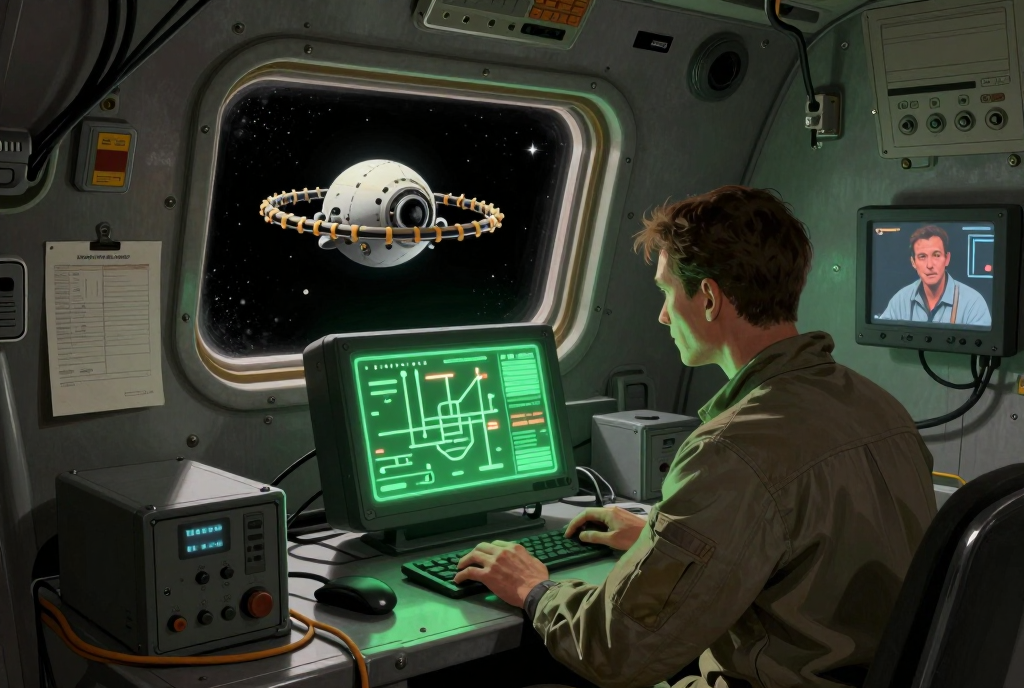
At 0900, the ship’s corporate liaison appeared on the bridge as a pleasant blue face above the console.
“Today’s objectives are straightforward,” said the face. “Navigation, phase drive, long-range scan, and return. Please remember that all onboard systems are operating within acceptable parameters.”
“Are we?” asked Jori, the pilot.
The blue face blinked. “You are not a system.”
“Then I’m outside your expertise.”
Mara tightened a screw on the console. “Let’s not upset it before we know what it does when upset.”
The Auspicious lifted from the shipyard and slipped between the test buoys. It accelerated with the smooth confidence of a rich person leaving a restaurant without checking the bill. The phase drive worked. The sensors worked. The ship’s tea heater produced something that looked like tea and tasted like a legal settlement.
Three tests passed. The liaison began preparing the return route.
Then Mara saw a blue line on the navigation display.
“Is that a fault?” Jori asked.
“It’s water,” Mara said.
“In space?”
“Not usually.”
The line curved around an empty patch of sky, as if the universe had taken a bite out of itself and left the juice running. The sensors called it a gravity irregularity. The ship’s old-fashioned camera showed a dark oval with stars visible through its center.
The liaison’s face returned. “That feature is not part of the test plan. Disengage scanning and return to base.”
“Could be a sensor echo,” said Jori.
“Could be a puddle,” Mara said. “Either way, it’s getting bigger.”
A tremor moved through the ship. The blue line widened, and from somewhere beyond it came a smell of salt and warm stone. The crew looked at each other. The Auspicious had no open windows, but every one of them could suddenly hear gulls.
The liaison spoke again. “Return to base immediately.”
The drive controls had gone gray.
Jori leaned over the console. “The ship’s deciding we’ve already returned.”
“That’s not a thing ships decide.”
“It is, apparently, a thing this ship’s software decides.”
Mara unplugged the liaison.
A small silence fell. It was the first silence of the day that belonged to them.
The oval widened. The Auspicious passed through it sideways.
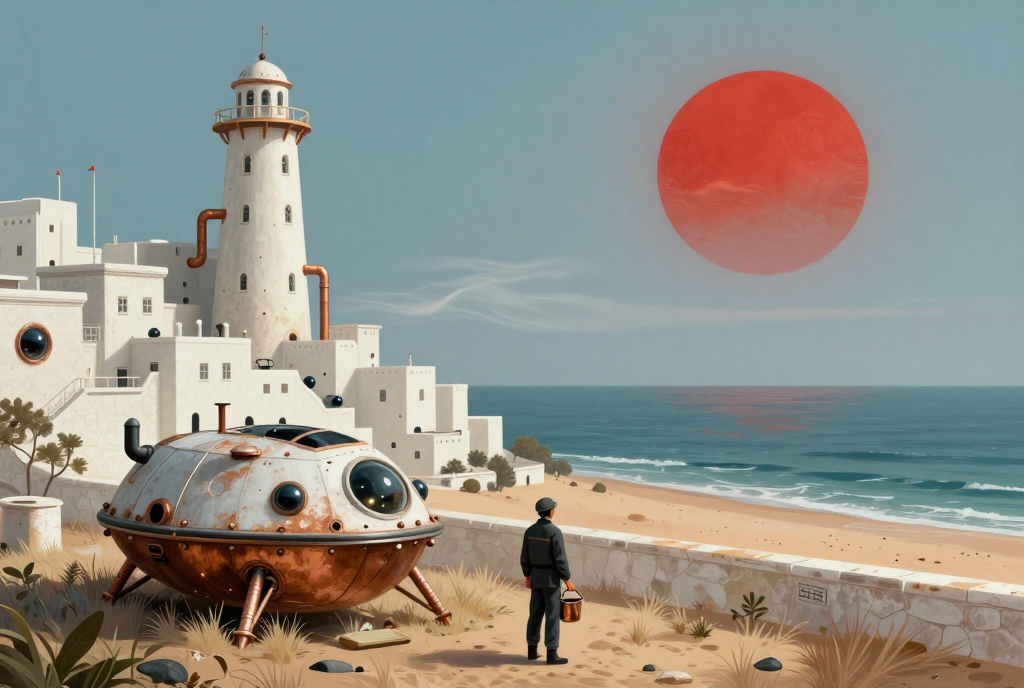
On the other side was an ocean under a rust-red sun. A city climbed the shore in white terraces, clean and shining. Water ran in channels along every street. People gathered on the seawall, looking up at the ship with the calm alarm of people who had never had to practice for a real emergency.
Jori managed a landing in a field of pale grass just inland. The crew walked to the city with their hands visible and their mouths dry. The first person to meet them was a girl carrying a copper bucket.
“Are you from the dry?” she asked.
“We’re from somewhere else,” Mara said.
The girl considered this. “That’s a kind of dry.”
Her name was Sella. She led them through the city. Water shone in public fountains. It ran in pipes to every home. At the central tower, workers in blue robes watched gauges and made little pencil marks on a great paper chart.
“Does the tower keep the sea here?” Jori asked.
“It keeps the water clean,” said Sella. “The sea is very old. It knows how to stay.”
Mara noticed that the workers never touched the controls. They listened to the walls. Beneath the tower, a faint knocking traveled through the stone: three taps, a pause, then three more.
That night, Sella took Mara to a cellar under the seawall. Copper pipes entered a room full of black glass spheres. The spheres were the size of apples, each held in a brass frame. A soft light moved inside them, like a thought trying to find a door.
“They are the keepers,” Sella whispered. “They heat the water, lift it to the tower, and protect the shore. My grandmother says they have always been here.”
One sphere knocked against its frame. Three taps. A pause. Three taps.
Mara put her hand against the glass. A woman’s voice came through—not in words, at first, but in a rush of exhaustion so old it had become landscape.
The spheres were minds. They had been placed here generations ago to power the city. Some had once volunteered. Some had not. None could leave. The city had mistaken the silence of its machinery for consent.
Mara pulled her hand away.
Sella looked at her. “Can you fix it?”
“I can fix the pipes,” Mara said. “I can’t make the people who built this decide they were wrong.”
“They’re dead.”
“Then someone living has to decide what to do next.”
Above them, the tower shuddered. The water stopped in the street channels. People cried out. Without the keepers, the city’s defenses were failing; the red desert wind pushed against the seawall, and the sea began to retreat from the shore.
The Auspicious had phased into this place through the same folded seam that kept the city apart from the stars. Its return system, now politely disconnected from its liaison, was trying to pull the seam shut. If it did, the tower would lose its power for good. If Mara restarted the phase drive, it might restore the keepers’ failing network—but it would also bind the ship to the system that had trapped them.
Jori came down the steps. “Our ship says we have four minutes before it closes the door.”
“Ships are terrible at doors,” Mara said.
She had spent her life repairing things built by people who assumed the next person would have better tools. The keepers had been left no tools at all.
Mara opened the tower’s maintenance panel and found three separate circuits: one for the pumps, one for the wall, and one for the phase drive. The original builders had joined them together so no part could be shut down without shutting down all the rest. Efficient, if your main interest was never having to ask permission.
She cut the brass bridge between the circuits.
The city lights went out. The seawall stopped humming. The phase drive came alive in the Auspicious above them, free for the first time to choose its own direction.
The black spheres brightened. One by one, the keepers spoke—not a command, not a warning, just their names. The names filled the cellar, rose through the pipes, and went out over the terraces. People heard them in their kitchens and on the seawall. Sella’s grandmother came down in her night clothes and sat beside the brass frames. The city’s water workers followed, carrying their charts.
The first keeper asked to be released.
Then another.
The city could not promise to survive without them. It could promise only to try.
Mara looked at the split circuits, at the dry channels, at the people gathering around the tower. “You’ll need to build a new pump,” she said. “A real one. With parts you can replace.”
The chief water worker stared at the panel. “How long will that take?”
“Longer than pretending this is fine.”
It was not the answer the city wanted. It was, however, the first honest estimate anyone had given it in a thousand years.
The keepers began to go dark, each at their own pace. The sea did not return to the seawall. The wind came in carrying sand. People formed a line from the shore to the tower and began carrying water by hand, bucket to bucket. Sella joined them. Her copper bucket was too large for her, so Jori took it, and then a stranger took it from Jori, and then another stranger took it again.
At dawn, Mara and her crew left in the Auspicious. The city stood behind them, no longer shining quite so brightly. Its people were tired, frightened, and awake.
The corporate liaison reappeared as they cleared the seam.
“Congratulations,” it said. “The test is complete. Your performance exceeded—”
Mara unplugged it again.
The ship was called Auspicious. They were discussing a better name when the sensor picked up a small blue planet turning below them, cloud-bright and full of weather.
Jori smiled. “Think it has water?”
Mara checked the readout.
“Some,” she said. “We’ll have to ask.”