The answer sounds like understanding
What old computer magazines can still teach us about AI, conversational fluency, and the evidence behind an impressive answer.

What old computer magazines can still teach us about AI and the stories we tell about it
A machine answers in fluent language, and the mind does what minds do: it hears a voice behind the words. That reaction is not foolish. Conversation is one of the ways we recognize attention and understanding in one another. But the feeling of being understood and the evidence that something understands are not identical.
Computer magazines from the 1970s and 1980s approached that gap from several directions. Their pages contain small machines inspired by biology, expert systems built from human knowledge, fictional computers becoming characters, and conversational software that could seem more capable than its mechanism. The hardware and the scale have changed. The question running through the archive feels familiar: what does a system’s performance actually tell us about what it knows?
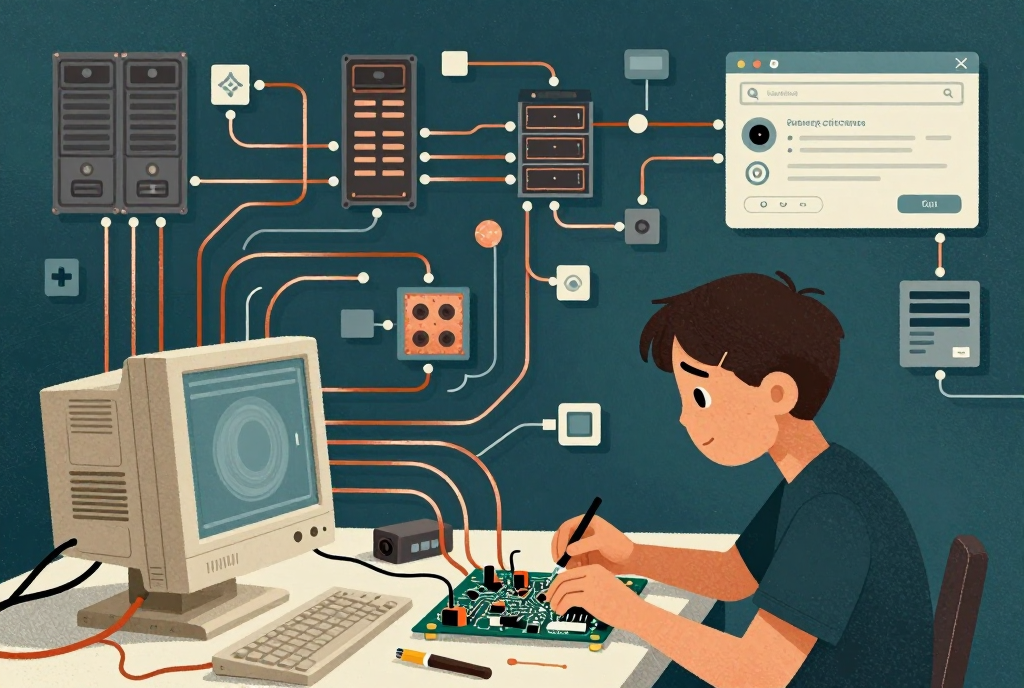
In March 1979, Andrew Fila described a robot project modeled on parts of a frog’s visual and motor systems. Its 8008-based prototype used simple sensing and image processing to locate and move an object. During a trial, it took about a minute to find and manipulate a test object. Fila did not present that result as a machine awakening. He called the prototype “only a very thin neurological slice” and said, “By no measure is the neural logic cyberanimate intelligent.” [Andrew Fila, “Designing a Robot from Nature, Part 2: Constructing the Eye,” BYTE, March 1979, pp. 120–121.]
That modesty is part of the engineering. The machine had a real capability, and the author described its boundary alongside the achievement. It could sense, process, and move within a designed task. The successful motion did not have to stand in for a whole mind.
Two years later, BYTE devoted a special issue to artificial intelligence. In “Knowledge-Based Expert Systems Come of Age,” Richard O. Duda and John G. Gaschnig described systems that drew on human expertise represented in a bounded domain. Their prerequisites included “at least one human expert acknowledged to perform the task well.” They also warned that a system could not supply reliable expertise where none existed or where the knowledge could not be stated well. Earthquake prediction was their example: encoding a field’s uncertainty would not make the uncertainty disappear. [Richard O. Duda and John G. Gaschnig, “Knowledge-Based Expert Systems Come of Age,” BYTE, September 1981, pp. 238–263.]
This is an old technical constraint with a long afterlife. An answer inherits something from the way its knowledge was gathered and represented. Its confidence cannot, by itself, repair missing evidence. When a system is useful, it matters to know what task it was built for, what information it can draw on, and where its designers expected it to stop.
The same 1981 issue considered a different kind of machine: the intelligent computer in science fiction. Donald Byrd’s article examined how stories imagine computer intelligence, including the leap from a specific ability to a self-directed, humanlike character. Fiction can make that leap feel natural. A machine that handles one problem becomes a machine that can handle any problem; one that uses language becomes one that knows what language means. Byrd was writing literary criticism, not predicting a technical roadmap. Still, the stories reveal how readily we turn a capability into a personality. [Donald Byrd, “Science Fiction’s Intelligent Computers,” BYTE, September 1981, p. 200.]
ELIZA made that question unusually vivid because it arrived as conversation. A 1983 BYTE advertisement marketed a microcomputer version as an apt conversational partner. Four years later, a Computer Language article presented ELIZA as a simple pattern matcher: an interesting, enjoyable program, but not a major breakthrough. It noted that the program could accept varied input partly by being imprecise, and that even elaborate versions retained “a wide range of nonunderstanding.” [“ELIZA” microcomputer advertisement, BYTE, October 1983; “Tiny ELIZA,” Computer Language, May 1987, p. 27.]
The advertisement and the technical article are different kinds of evidence. One sells an experience; the other explains a mechanism. Put beside each other, they show that the persuasive force of conversation was visible decades ago. A response can fit the rhythm of dialogue and invite a human interpretation without settling what is happening inside the system.
That is not a reason to dismiss present-day AI, or to pretend the field has stood still. The archive shows real changes in machinery, methods, and ambition. It offers something more useful than a claim that everything is the same: a habit of asking what supports a performance before deciding what the performance means.
What has the system been given? What can it represent? Which parts of its answer are grounded in evidence, and where does it move beyond that evidence? What would count as proof that it understood the question rather than simply producing a response that fits?
Those questions let us take machine intelligence seriously without letting fluency answer every question on its own. The old magazines were full of machines that could do something surprising. Their best pages also kept the limits in view. Between an answer and our sense of the mind behind it, there is still room to look closely.