The Long Way from Opening the Case to Building the System
A hands-on systems engineer’s path from repairing computers to tracing connections across networks, communications, and search—and the curiosity that kept pulling him toward the next thing to understand.
The Long Way from Opening the Case to Building the System
Before Bryan Vest was connecting information across complicated systems, he was learning what happened when you opened one up.
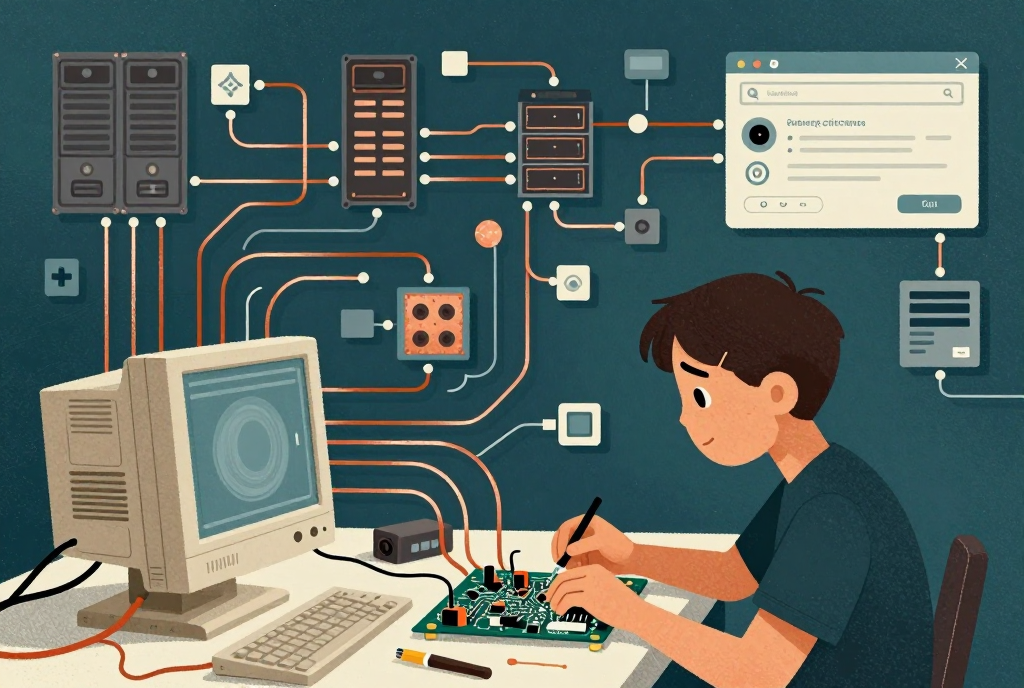
His technical life began close to the hardware: a computer on a bench, a problem that didn’t explain itself, and the practical work of finding out what had failed. He trained in electronics repair and spent the early part of his career repairing and supporting computers. That was a useful education in the difference between a system diagram and the machine in front of you. Components age. Cables come loose. Software misbehaves for reasons that sound ridiculous until you find the one detail everyone else missed.
The work grew outward. Computer support led toward networks; networks led toward the infrastructure that keeps communications moving. Over the years, Bryan worked across Linux systems, telecommunications, internet service operations, and distributed search. The technologies changed, but the recurring task stayed familiar: take a symptom, gather the evidence, trace the relationships, and keep going until the explanation fits what the systems actually did.
That path matters because it wasn’t a clean march from one specialty to another. It was more like acquiring new floors in the same building. A problem in a telephone call might touch signaling, routing, servers, customer equipment, and a database record. Search infrastructure could turn out to be part of an operations problem. A little code might be the shortest route between information that already exists and the person who needs it. Bryan’s work has repeatedly put him in the seams between systems—the places where one team’s “not ours” meets another system’s missing clue.
He seems to enjoy those seams. Bryan thinks in relationships and patterns, and his first instinct when something goes wrong is often to ask what changed. He trusts what can be observed: logs, records, packet captures, a reproducible failure, or a machine behaving strangely right in front of him. Titles and confident explanations count for less if the evidence points somewhere else. There is impatience in that, certainly, but also a particular kind of curiosity: the satisfying moment when a confusing failure stops being mysterious because somebody followed the trail all the way through.
That curiosity doesn’t switch off when the immediate problem is solved. Bryan likes experimenting with technology simply to see what becomes possible. He can be interested in an older telephone system and a new AI model for the same reason: both have behavior worth understanding. He has built practical tools to connect scattered operational information, and he has accumulated a personal digital archive whose contents span different machines and different periods of life. In each case, the question is less “How impressive is the technology?” than “What can I learn if I give this thing enough context and actually try it?”
There’s a builder’s instinct in that question, but not the polished, keynote version of a builder. Bryan is less interested in announcing a grand architecture than in finding the part that doesn’t make sense, opening the case, and tracing the route. Sometimes the result is a system other people can use. Sometimes it’s a better explanation. Sometimes it’s a new experiment that begins with a shrug and: what happens if I try this?
The tools have become more abstract over the decades. The habit hasn’t. Look closely. Follow the evidence. Learn how the pieces fit. Then see what else might be possible.