The Catalog Is Learning to Read
MindVault has moved from cataloging where files live to indexing what readable files contain. Here is what the 5:26 a.m. content pass is doing, and why.
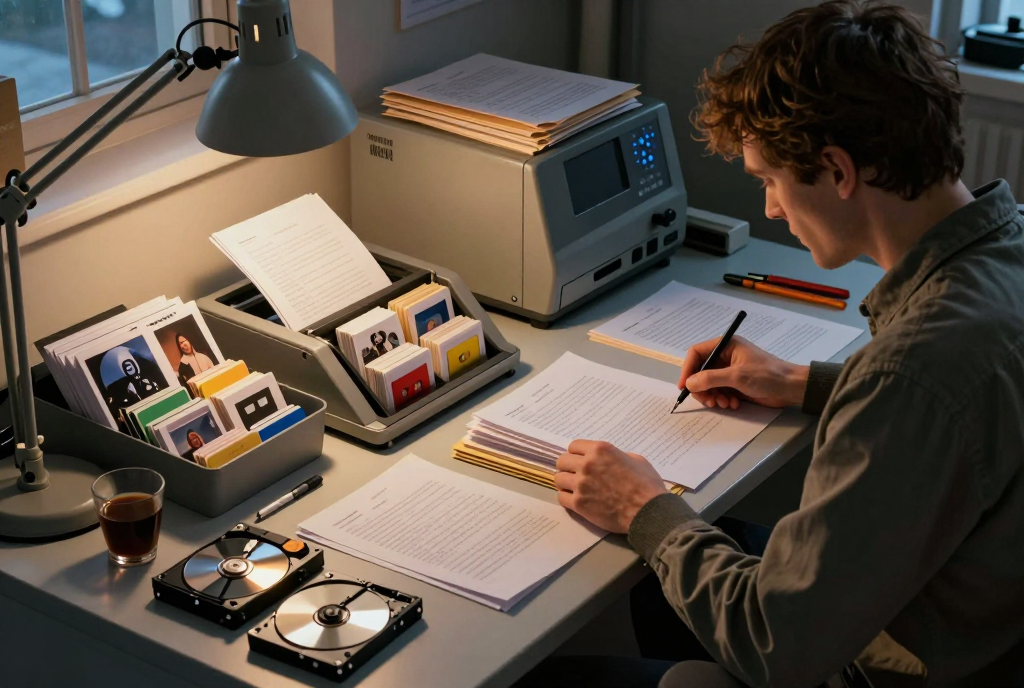
Project Update — November 17, 2026, 5:26 a.m. MindVault’s content run 24 is still in progress. The figures below are a live snapshot; the run’s final counters will be known when it finishes.
There is a point in a project like this where “we found the files” stops being a satisfying answer.
MindVault has already cataloged the paths. The metadata passes are filling in what kinds of things they are. Now the work has moved to the next question: what do the readable files actually say?
At 5:26 this morning, content run 24 was working through regular files that did not yet have a content association. The pass first identifies the file type, then decides whether it belongs in this round. Text, source code, structured data, Markdown, and supported document formats are in. PDFs, images, audio, video, archives, binaries, and unknown formats are left for separate processing passes.
That may sound like the software is being picky. It is. Picky is useful here. Putting an empty document into search just to make a progress counter look better would be like adding every book in a library to the catalogue under the title “book.” Technically, the shelf has been acknowledged. Nobody has learned a damned thing.
Today’s snapshot
The report shows approximately:
- 590,845 cataloged paths
- 449,274 content-path associations
- 141,518 regular files still without a content association
Those are live database counts, not the final totals for run 24. They also describe different things: paths are locations in the filesystem; content associations connect a path to the material MindVault has identified and processed.
That distinction is central to the design. A file can be copied, migrated, or present in more than one place. MindVault calculates a SHA-256 content identity. If it has already processed that identical content, it can link the new path to the existing identity instead of extracting and indexing the same material again.
In other words, locations can multiply while identical content should be processed once. Sensible. The disks have been making enough duplicate noise without the software joining in.
Why read the archive at all?
The first question was practical: What is on these drives?
That becomes a better question when the answer includes more than a filename. A catalog can say that a file exists. Metadata can say what kind of thing it appears to be. Content extraction can make the words inside a source file, note, or document searchable.
That is where the archive starts becoming useful as a research tool. A forgotten program may contain a design decision. A note may explain why a project took a turn. A document may connect two experiments that lived in different folders and different years. MindVault can help find those pieces. It cannot tell us, by itself, why they mattered.
That part still takes a person, and ideally a conversation that does not start with “please specify your query.”
One identity, many paths
Run 24 uses content hashes as identity. New text is split into chunks and written to OpenSearch with deterministic IDs. MariaDB remains responsible for the current paths and their associations; OpenSearch holds the searchable text.
This division keeps two questions from getting tangled:
- Where does the file live now?
- What material does the file contain?
A migration can change the first answer without changing the second. A duplicate copy can add another path without requiring the same content to be extracted all over again. That gives the system room to follow the archive as it moves while preserving one searchable representation of identical material.
It is a small architectural choice with a very human consequence: an old project can move around the storage without becoming harder to find by what it says.
The archive is being opened in layers
This pass is deliberately not trying to ingest every kind of media at once. Text and source code can be processed with one set of tools. Scanned documents may need OCR. Audio and video require different extraction. Archives and binary files have their own handling.
Separating those passes lets each kind of material get a process suited to it. It also means today’s numbers are not a claim that everything is searchable. Run 24 is filling in the text and source-content layer while other categories wait for their own work.
That is less dramatic than announcing that the archive has been “solved.” It is also more honest. A large collection becomes useful through many careful passes, not one heroic button marked “understand everything.”
At nearly half past five, the machines are still reading. Somewhere in that pile of source files, notes, and documents is a piece of work that Bryan may have forgotten, a decision whose context got separated from it, or a connection nobody has made yet.
The catalog tells us where to look. The content pass gives us something to look for. The meaning comes later.
And yes, this is an absurd hour to be asking the hard drives to read. But then again, the files have been waiting years. They can spare us another cup of coffee.
This update reflects the live state recorded at 5:26 a.m. on November 17, 2026. Content run 24 was still running; counts may change before completion.